Showing posts with label SB 5. Show all posts

Sunday, November 6, 2011

Ohio Issue 2 - A Proper Redress (Part 3)

[Read Part 1 to see the reasons I believe the reforms in Issue 2 are needed]


[Read Part 2 to see how SB 5 affects safety forces]


In this post I'd like to discuss how Senate Bill 5 (SB 5) if enacted, will affect teachers. As I said in my previous post, there has been tremendous pressure to "support teachers," with the implication that a YES vote on Issue 2 is analogous to disrespecting teachers or being ungrateful for the work they do. In reality, the opposite is true.


SB 5 will affect teachers in significant ways and it's understandable that they would be concerned. In Part 1 of this series, I explained the new requirements for health care (15%) and pension (10%) contributions. For many teachers, this won't be a change at all, since they're already paying these amounts or more. 


The other game-changer in this piece of legislation is the elimination of automatic step-increases for public employees. Instead, they will be evaluated and paid, in part, based upon their performance.  Nearly everyone in the private sector earns raises based upon performance and they're permitted to continue on the job based upon performance. For public employees in Ohio, there are currently step charts dictating exactly how much each employee makes based upon things like length of service and education level. So each year, they receive a predictable raise, whether or not they have performed well.  Good teachers are paid exactly the same as bad teachers. Layoffs are made based only upon seniority. 


In the new system, teachers would be evaluated and compensated based upon the following:
Sec. 3317.13 (B) Each teacher shall be paid a salary based upon performance as described in this section: 
(C) For purposes of this section, a board shall measure a teacher's performance by considering all of the following:
(1) The level of license issued under section 3319.22 of the Revised Code that the teacher holds;
(2) Whether the teacher is a "highly qualified teacher" as defined in section 3319.074 of the Revised Code; 
(3) The value-added measure the board uses to determine the performance of the students assigned to the teacher's classroom; 
(4) The results of the teacher's performance evaluations conducted under section 3319.111 of the Revised Code or any peer review program created by an agreement entered into by a board of education and representatives of teachers employed by that board; 
(5) Any other criteria established by the board
Here's a video that describes how such a multi-faceted system works in the D.C. school system:


See Part 2 and Part 3.

School boards would use evaluations to make decisions about compensation, nonrenewal of employment contracts, termination, layoffs, and professional development.

The first thing to understand is that no salaries are changed by this law and teachers will still be negotiating wages through collective bargaining. The big change is that teachers will no longer be awarded raises just for showing up to work for another year. 


There will be a model assessment framework created by the Superintendent of Public Instruction (SPI) and the State Board of Education (SBE). This will be an open and transparent process, as SBE meetings are open to the public and all proceedings are subject to Ohio's Sunshine Laws.  Local school boards may use the SBE's model assessment or create their own, based upon the requirements of SB 5. 


Each board, in consultation with teachers, will create an evaluation system that:

(1) Is evidence-based and uses multiple measures of a teacher's use of knowledge and skills and of students' academic progress;
(2) Is aligned with the standards for teachers adopted under section 3319.61 of the Revised Code;
(3) Provides statements of expectation for professional performance and establishes specific criteria of expected job performance in the areas of responsibility assigned to the teacher.
(4) Requires observation of the teacher being evaluated by the person conducting the evaluation on at least two occasions for not less than thirty minutes on each occasion;
(5) Requires that each teacher be provided with a written report of the results of the teacher's evaluation that includes specific recommendations
Each teacher will be evaluated on the following, once each year in April:

The framework shall require at least fifty per cent of each evaluation to be based on measures of student academic growth specified by the department of education. When applicable to a teacher, those measures shall include student performance on the assessments prescribed under sections 3301.0710 and 3301.0712 of the Revised Code and the value-added progress dimension prescribed by section 3302.021 of the Revised Code
(1) Quality of instructional practice, which may be determined by announced and unannounced classroom observations and examinations of samples of work, such as lesson plans or assessments designed by theteacher;
(2) Communication and professionalism, including how well the teacher interacts with students, parents, other school employees, and members of thecommunity.
(3) Parent and student satisfaction, which may be  measured by surveys,questionnaires, or other forms of soliciting feedback.
Those of you who work in the private sector will likely read these requirements and find them familiar; this is how the majority of workers in Ohio are evaluated for raises and promotions. They certainly don't seem unreasonable. Those of us with children in the public schools would like to know that our children's teachers are on the job because they are competent teachers, not merely because they have a degree and a teaching license. 


It's important to understand that "student performance on assessments" is only used as an evaluation method "when applicable." So, for example, it would not be part of the art teacher's evaluation because there is no current mandated achievement test for art. The same for kindergarten. However, there would still be a requirement to measure "student growth" with a "value-added" dimension. For those not familiar with education lingo, this means that rather than a pass/fail system on mandated tests or assessments, the student's growth from year to year is the measure of success.  Who could have a problem with that?


Here's my take: If you're a good teacher, you're already doing all of this and you have nothing to fear from these reforms. If you're a great teacher, you may even be better-compensated for your efforts. If you're terrified that this new law will punish you in some way, then a little soul-searching is in order. Perhaps you're the reason we need performance pay.


There are a couple other items that might be of interest to teachers (and those who care about them).  The first is the provision that continuing contracts (tenure) will be retained for those who have already attained that status (ORC 3319.1). However, going forward, this will be eliminated. 


The other is a new provision that will ban forced fair share dues to unions. If teachers (or other public employee at a union-represented workplace) decide that they don't want to continue to fund the Ohio Education Association's liberal political agenda - namely funding the Ohio Democratic Party - they can now opt out without being forced to pay fair share dues. 


In most cases, paying fair share dues is the same as paying union does. In either case, the employee still receives union representation in contract negotiations. See here for an example of the differences.  The union bosses hate, hate, hate this provision because they know many people aren't thrilled about about its leaders, who pull in six-figure salaries and run an organization rampant with waste, fraud, and abuse. They know that if given the opportunity, union members will bolt and the money will dry up. But it's great news if you're a conservative teacher and you're tired of being shaken-down for union or fair share dues.


I realize this is a tough sell to teachers. I've heard stories of young teachers who have been pressured at work to sign the petitions and work for a NO on Issue 2. I also realize there's a conflict for some between an ideology of fiscal conservatism and a need to provide for one's own family. In a sense, this is where the rubber meets the road.


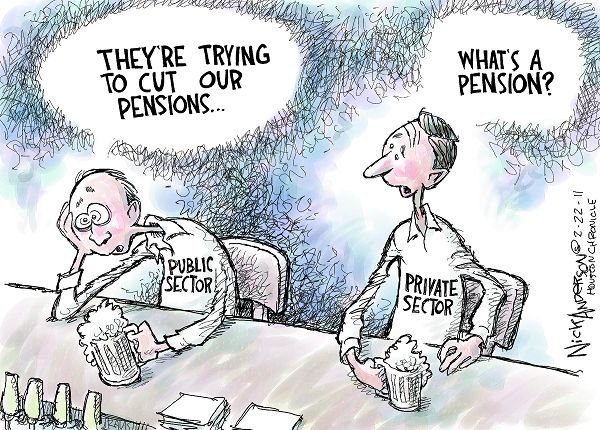
If you are a teacher, please understand that we don't all think you're greedy or that you've single-handedly bankrupted the state. We appreciate what you do for our kids. But also please understand that these adjustments you are being asked to make are the same ones we in the private sector have been making for years. Our family's health insurance costs have skyrocketed in recent years to $700/month. 


A couple years ago, my husband's employer cut back their contribution to his 401K, from 6% to 3% due to the economic downturn. While we were disappointed by the reduction, we were glad that it wasn't a layoff notice and glad the company is fiscally responsible - that they haven't had to make layoffs when many other companies have (they reinstated the the full contribution this year).  For that matter, we're grateful that they contribute anything at all.  Many private sector employees don't have retirement funds at all and, like my mother-in-law, will depend entirely on a meager Social Security check in retirement. 


I hope teachers and those who want to support them will consider voting YES on Issue 2. In addition to giving school districts tools to control their budgets and help avert layoffs, it will help to keep and reward the best teachers, which is best for the kids. 


Saturday, November 5, 2011

Ohio Issue 2 - A Proper Redress (Part 2)

[Part 1 - Why reform is needed]
[Part 3 - Teachers]

If you live in Ohio, you know about Issue 2, which is a referendum to stop the union/public employment reforms enacted by the state legislature and signed into law by Governor Kasich. The airwaves have been filled with emotional ads featuring teachers, firefighters, nurses, paramedics, and police officers. 

Unfortunately, much of the rhetoric has seemed personal. If you say you are voting YES on Issue 2 (voting for the reforms), you're told you are trying to "destroy the middle class" (even if you are middle class yourself), you want to put safety forces in danger, and you want to see your child's teacher unemployed (and poor). It's no wonder there are very few Yes on 2 signs in Ohio yards. Who would want to admit to all that? 

To ramp up the emotional blackmail appeal, the AFL-CIO is now running ads with firefighters who served our country as soldiers in Iraq and Afghanistan.  In one ad, a Columbus firefighter and war veteran says:
"I never expected to have to fight our own government… to have a voice in my own safety and work conditions."
From the AFL-CIO blog:
“We didn’t expect this kind of homecoming when we came back,” says Columbus fire fighter David Jarvis, who served in Afghanistan following the Sept. 11, 2001, terrorist attacks and served in Operation Desert Storm during the first Gulf War."
The claim that public employees will not have a "voice in their own safety and work conditions" has been repeated throughout the campaign and I suspect it will convince a lot of people to vote to strike down the reforms in SB5. We've been told that not only will police and firefighters be in danger, but our own families will be as well.  One radio ad featured a 911 call with the dispatcher telling a frightened family with a robber in their home that the police wouldn't arrive for 20 minutes because they were short staffed.  Listeners were told this is what we should expect if Issue 2 passes. 


But is it true?


The answer depends upon which question you're asking. Let's try to unravel a few of them.


First, let me take a minute to explain exactly what Senate Bill 5 (SB 5) is. Many of its opponents have claimed that it's 300 pages long and very confusing.  The Fraternal Order of Police of Ohio said, "This 300 page bill is very complicated and proposes to make numerous, substantial and interrelated changes in the law." That's a half-truth, at best. 


The introduction to SB 5 says, 
"AN ACT To amend sections [then it lists dozens of sections] of the Revised Code to make various changes to laws concerning public employees, including collective bargaining, salary schedules and compensation, layoff procedures, and leave."
The vast majority of the 300 pages of this Act, which became a Bill (SB 5) and then became a law (remember School House Rock? I'm Just a Bill?), are sections of the Revised Code that have remained unchanged. The entire text of each section that has even one word changed must be included, which means that a LOT of ink is spilled when ever there is a new law passed!  Here's an example:

(C) Unless a public employer specifically agrees otherwise in an express written provision of a collective bargaining agreement, nothing in Chapter 4117. of the Revised Code impairs the right and responsibility of each public employer to:
(1) Determine matters of inherent managerial policy which include, but are not limited to areas of discretion or policy such as the functions and programs of the public employer, standards of services, its overall budget, utilization of technology, and organizational structure;
(2) Direct, supervise, evaluate, or hire employees;
(3) Maintain and improve the efficiency and effectiveness of governmental operations;
(4) Determine the overall methods, process, means, or personnel by which governmental operations are to be conducted;
(5) Suspend, discipline, demote, or discharge for just cause, or lay off, transfer, assign, schedule, promote, or retain employees;
(6) Determine the adequacy of the work force;
Wherever something is crossed out, it means something has been removed from existing law. When something is underlined, it has been added. Text with no markings is current law that remains unchanged. If you take a minute to skim through the new law, you'll see that the majority of it remains unchanged. Opponents of SB 5 would have us believe that the Republicans add 300 pages of new laws. That's simply not true.
Now back to the issue of safety forces. At issue is this:
(B) The following subjects are not appropriate subjects for collective bargaining:
(5) The number of employees required to be on duty or employed in any department, division, or facility of a public employer
 (F) Notwithstanding division (C) of this section, equipment issues directly related to personal safety are subject to collective bargaining.
If you've been following along, you noted that this is underlined, so it's been added to existing law.  So it's true that public employees will not be allowed to collectively bargain for staffing levels.  However, claims that it would be "illegal" for public employees to talk to their employers about staffing levels are merely hyperbole. No firefighters or teachers will be thrown in jail for expressing their opinions about staffing levels and exercising their First Amendment rights. The new law just says that it can't be a subject of the "official" collective bargaining process. 


Note also that safety forces can collectively bargain for safety equipment. This is a new right that they did not have before SB5.  Apparently the unions are not telling their members this, because I've seen comments all over the blogs saying they will not have this right if SB5 is enacted. 


However, the more important question is whether that will make them (and us) less safe. Since individual police officers, firefighters and paramedics won't be deciding on staffing levels, it will be left to the discretion of management - that means fire and police chiefs. Of course, they will have to work within the budget dictated by the local government unit, but why wouldn't they be competent to make intelligent, informed decisions about staffing levels? They have years of experience in their areas of expertise and are well-qualified for this task. 


Opponents of Issue 2 would have us believe that miserly city councils and township trustees would immediately slash budgets and cut safety forces down to skeleton crews in order to build new dog parks.  What motive they supposedly have for putting their constituents and their own families in danger, I do not know. 


The truth is, there is not an unlimited pot of money from which to pay safety forces, though Ohio governments have lived in that fantasy land for many years now. In the past, when unions would show up at the bargaining table to demand more, more, more, an impasse could result in binding arbitration, where the recommendation (and mandate) might be for the city to borrow money to meet the demands.  SB 5 gives local governments tools to control their budgets including controlling staffing levels, eliminating binding arbitration, and requiring public employees to pay minimal amounts toward their health care and pensions. 


The result of not enacting these reforms is the real danger. With bloated budgets and unsustainable projected deficits in cities across the country, layoffs will be necessary. That is a far more serious concern than trusting fire chiefs and police chiefs to decide staffing levels based on actual, realistic budgets. The money pot has run out and cities need these tools to keep us safe and to keep us from fiscal disasters. 

Wednesday, April 6, 2011

April 6, 2011

Interview with Rep. Allen West (R-FL) |  The Public Square
One of my favorite organizations, the American Policy Roundtable, has an hour-long program which includes an interview with freshman Congressman Allen West (R-FL).  I've been a huge fan of West since I heard his CPAC keynote address last month.  He's a patriot and a thoughtful, solid conservative. APR's interview with Rep. (and Army Lt. Col.) West will encourage you!  His knowledge on a wide range of topics is dizzying.  Seriously, who knows the name of Muhammad's first wife?  He combines that intellect with real life experience with radical Islam as a commander of our troops in Afghanistan and Iraq and a reverence for the Bible. 


If you don't have time for the hour-long program, you can listen to a two-minute spot from David Zanotti and Wayne Shepherd with some background information about Congressman West and his qualifications to speak about radical Islam:


~~~~~

Speaking of Congressman West, his first bill in Congress passed unanimously this week, a waste-eliminating cut in the defense budget (that some have said for years was off the table):

"The House on Monday unanimously approved a bill sponsored by South Florida Congressman Allen West – his first bill passage since coming to Congress – that would cut the Defense Department's printing costs. 

'We all still rely on paper,' West, a Republican from Plantation, told the House. 'But I do not understand why we need examples of these highly expensive glossy color briefing slides and slick books that DOD sends over here.' 

The bill – passed by a vote of 393 to 0 -- would cut the Pentagon's proposed $357-million printing costs for next fiscal year by 10 percent, or $35.7 million."
~~~~~

Another APR program I've really benefited from was an interview with Dr. Wayne Grudem on the topic of "God and Politics," based on his book of the same name.  Grudem and hosts David Zanotti and Wayne Shepherd have a great discussion about the role of Christians in the political realm, both in biblical times and the present day.


 "During the month, according to the Treasury, the federal government grossed $194 billion in tax revenue and paid out $65.898 billion in tax refunds (including $62.011 to individuals and $3.887 to businesses) thus netting $128.179 billion in tax revenue for March.
At the same time, the Treasury paid out a total of $1.1187 trillion. When the $65.898 billion in tax refunds is deducted from that, the Treasury paid a net of $1.0528 trillion in federal expenses for March."
NASA warned hackers could take over space station  World Net Daily
"Paul Martin, the NASA inspector general, is reporting NASA's computer network was so vulnerable to cyber attack that computer hackers could take control of a spacecraft while in flight, according to a report from Joseph Farah's G2 Bulletin.
In part, the report states, 'We found that computer servers on NASA's agency-wide mission network had high-risk vulnerabilities that were exploitable from the Internet. Specifically, six computer servers associated with IT assets that control spacecraft and contain critical data had vulnerabilities that would allow a remote attacker to take control of or render them unavailable.
 "The implications of penetrations into NASA's network are staggering. NASA's network consists of 190 interlinked computer systems and is widely distributed throughout the United States."
~~~~~

 Socialized Medicine Director Dies Waiting for Operation  The New American (HT: Glenna)
"Margaret Hutchon, a former mayor, had been waiting since last June for a follow-up stomach operation at Broomfield Hospital in Chelmsford, Essex.
But her appointments to go under the knife were cancelled four times and she barely regained consciousness after finally having surgery.
Her devastated husband, Jim, is now demanding answers from Mid Essex Hospital Services NHS Trust — the organisation where his wife had served as a non-executive member of the board of directors.
He said: 'I don't really know why she died. I did not get a reason from the hospital. We all want to know for closure. She got weaker and weaker as she waited and operations were put off.'
Not to be cruel, but the reason is simple.It’s called government-run health care."
 The article continues with many more instances of death and suffering as a result of Britain's government healthcare program. 


~~~~~


Cleveland school board lays off 643 teachers, closes 7 schools | cleveland.com: 
"[The Cleveland School Board] laid off 643 teachers, some for the third time in the last seven years. 
The board also closed seven of its 94 schools, including Giddings Elementary where Freeman teaches. In all, the cuts aimed at stabilizing the district financially along with slight revenue increases total nearly $73 million....
... The Cleveland layoffs are based on seniority and certification. Under Ohio's recently signed collective-bargaining law, formerly known as Senate Bill 5, performance not seniority would be the primary factor in determining teacher layoffs. However, the new law does not apply to these layoffs because they are being carried out under an existing contract....
...The cuts are equal to about 10 percent of the current operating budget. Interim Chief Executive Officer Peter Raskind said his goal was to wipe out a $47.5 deficit forecast for next school year, as required by state law, and get the district through 2012-13 without further upheaval."
Part of problem in the Cleveland school district is the severe population decline.  Ten years ago there were 70,000 students.  Today there are only 45,000.  When you lose 25,000 students, you can't expect to keep all these schools open and maintain the same staffing levels.  Parents and teachers are outraged, as  they usually are when this happens, but it's a hard, cold reality: fewer students = fewer teachers, administrators, and buildings. 


The solution for parents is to have a robust school choice program in Ohio.  Those who care about poor children in failing inner-city schools should be marching in Columbus, Wisconsin, and D.C. on behalf of school choice initiatives - to get these children OUT of failing schools IMMEDIATELY.  They cannot wait another 5 years while their school districts dither around with dubious Race to the Top bureaucracies like implementing longitudinal data systems and adding layers and layers of admistrators.  In five years it will be too late for many of these children.    

Unions want members to pay for SB 5 referendum | Columbus Dispatch Politics: 
"Betting on an expensive referendum drive, opponents of Senate Bill 5 are turning to rank-and-file union members to help cover campaign costs predicted to reach $20 million.
At least three statewide labor organizations - the Ohio Education Association, the Ohio Fraternal Order of Police and the Ohio Association of Professional Fire Fighters - are considering charging members extra fees to fund a ballot effort to repeal a GOP-backed bill signed by Gov. John Kasich last week that would limit collective-bargaining rights for state- and local-government employees
We Are Ohio, the coalition of union supporters pushing for the referendum, yesterday delivered proposed petition language and nearly 3,000 signatures to the Ohio secretary of state and attorney general - the first step toward making the Nov. 8 statewide ballot.
In an email dated March 22 and obtained by The Dispatch, Ohio Education Association executive director Larry Wicks said teachers and other unionized school personnel might be charged a one-time assessment of $50 to generate more than $5 million to fight Senate Bill 5. A spokesman said yesterday that the OEA's representative assembly will vote on the charge in early May.
Wicks said in his email, 'At least $20 million will be needed to run an effective campaign.' He also said a referendum effort was 'not a slam dunk.'...
..."In an email to union members, Jack Reall, president of the Columbus firefighters union, said statewide leaders will meet Thursday to consider charging $100 per member for the referendum campaign. Jay McDonald, president of the Fraternal Order of Police of Ohio, said a decision will be made on a member charge this week.
Also wading into the referendum effort yesterday was former Gov. Ted Strickland, who, in a fundraising email obtained by The Dispatch, asked supporters for $5, $10 and $25 donations to the Ohio Democratic Party."
In case you're wondering why this is going to the voters after it was passed by both houses of the legislature and signed by Governor Kasich, it's because the Ohio Constitution allows Ohio's citizens to bring a referendum (or even an amendment) to the ballot as long as they can collect enough signatures to get it on the ballot.  For a referendum, SB5 opponents will need to gather signatures equal to 6% of the number voting in the most recent gubernatorial election, which means they'll need 231,149 signatures by the June 30 deadline to get it on the November ballot.


 Senate Bill 5 supporters slow to organize | The Columbus Dispatch: 
"From Kasich's office to various tea party headquarters to the Ohio Chamber of Commerce, belief is strong that someone will step forward to lead a campaign in favor of Senate Bill 5 and coordinate fundraising, if and when a referendum is placed on the November ballot.
Talk of such a coordinated effort in Ohio is at present relegated to back channels, while Democrats and labor leaders are galvanized for war - and with more than $5 million available just from the Ohio Education Association, should it approve a plan to charge its members a one-time assessment of $50 to support the referendum.
'The bottom line is that it's better to be engaged sooner rather than later,' said Andy Doehrel, president of the Ohio Chamber of Commerce. 'I expect us to be involved, but how or what the time frame is, I just don't know that at this time.'
This is not a good sign, considering how well-organized and well-funded opponents of this bill are and considering that they are planning to force their union members to contribute to the effort.


The key to defeating the anti-SB5 referendum may lie here:
"Chris Littleton, president of the Ohio Liberty Council, an affiliation of 65 tea party groups, said his members will help support Senate Bill 5.
But Littleton said if the council had to choose, its priority would be to back a constitutional amendment that would strike down the compliance component of the federal health-care law passed in 2009.
Littleton said his group needs 150,000 more signatures by July to guarantee that the amendment question is placed before voters in November."
If BOTH of these issues make it onto the ballot, they will help each other because voter turnout for one will garner votes for the other issue, which likely includes crossover supporters.  Some voters who would make the effort to go out and vote for an amendment to opt out of Obamacare might also vote against the anti-SB5 referendum and vice-versa.  The more these issues can be tied together under the mantle of fiscal responsibility, the more they can mutually benefit each other and assure a positive outcome in November.